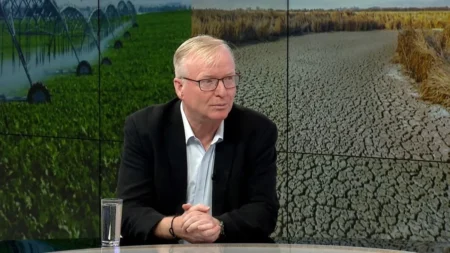
Climate change is no longer a warning about the future – it is already reshaping food production around the world. Longer heatwaves, droughts, floods and shifting rainfall patterns are reducing crop yields, increasing the risk of plant and animal diseases, and driving up food prices.
That is the warning from Professor James Whelan, one of the world’s most cited plant biologists, who is currently visiting Sarajevo. In an interview with N1, Whelan discussed how climate change is affecting food production, what it could mean for Bosnia and Herzegovina and the wider region, and why investment in agriculture and science is essential for the future.
Climate change is happening now
Whelan argues that one of the biggest challenges is not only climate change itself, but also the lack of serious public discussion about its consequences.
“Climate change is real, it is happening, and that is a fact,” Whelan said.
“Some people attack scientists who have devoted their lives to studying the issue. The topic does not receive the attention it deserves if we are to mitigate the consequences. This is an international problem and it requires a global effort.”
Lower yields and growing food insecurity
Speaking about agriculture, Whelan warned that while plants have natural defence mechanisms, there are limits to their ability to cope with extreme conditions.
“The problem with climate change is that yields will decline, which will lead to food shortages and, in turn, social unrest and conflict,” he said.
Many scientists, he added, believe the world is already approaching a critical tipping point.
“There is a basic law of nature: if it is too hot and there is no water, you cannot have yields.”
As an example, he pointed to Pakistan, where devastating floods caused major crop losses and created severe challenges for millions of people.
According to Whelan, no part of the world will be immune to the effects of climate change.
“Every region is affected differently. Some places will experience more rainfall, others less, but I do not think anyone will be immune,” he said.
While he avoided making specific predictions for Bosnia and Herzegovina, he noted that changing weather patterns are likely to affect virtually all agricultural crops.
Climate change is altering disease patterns
Beyond reducing agricultural output, climate change is also changing the spread of diseases.
“It is not only about crops. Climate change changes the disease profile. Diseases that were not previously present may emerge, while pathogens can survive in regions where they previously could not,” Whelan warned.
He stressed that this poses risks not only for plants, but also for animals and humans.
What will we eat in the future?
Whelan believes climate change could significantly reshape global diets.
“In the future, it may become difficult to maintain high levels of meat production because feeding livestock requires large amounts of crops,” he said.
“If people follow a completely vegetarian diet, you can feed roughly seven times more people than when food is converted into meat.”
He warned that increasing pressure on food production is likely to affect dietary habits, food culture and lifestyles around the world.
Food prices likely to rise
Climate change is already contributing to shortages of certain food products, Whelan said, and that trend is likely to continue.
“Food shortages and rising food prices can lead to widespread conflict if we fail to act in advance,” he warned.
He noted that several countries have already restricted exports of key food products following major climate-related disruptions, adding further pressure to global markets.
One of the lesser-known consequences of climate change, according to Whelan, is its impact on food quality.
“Plants respond to stress, and because of that they do not taste the same. Food will contain fewer nutrients and its flavour will not be as good,” he said.
Such changes could affect the quality of wheat, bread, pasta and many other products that depend on specific plant characteristics.
Farmers on the front line
Speaking about Bosnia and Herzegovina, Whelan stressed that farmers need stronger support from governments and society.
“Farmers are the best custodians of the land and they are on the front line of this battle,” he said.
“They need support from society as a whole – from governments as well as citizens.”
He argued that agricultural subsidies should not merely help farmers survive, but should be viewed as investments in long-term food security.
“We must protect farmers. We must help them grow the crops that will be important for the future and preserve the knowledge and skills needed to produce food.”
Investing in people and science
Reflecting on his visit to Bosnia and Herzegovina and his cooperation with local researchers, Whelan said the country has talented scientists and a strong educational foundation.
“People in Bosnia are very bright and the level of education is very good,” he said.
“The problem is that researchers often lack the resources needed to conduct work at a level that would gain broader international recognition.”
Ultimately, Whelan believes that investing in people is the most important investment any country can make.
“The best investment a government can make is an investment in people, because that is capital that is passed on to future generations,” he concluded.
Pratite nas na društvenim mrežama